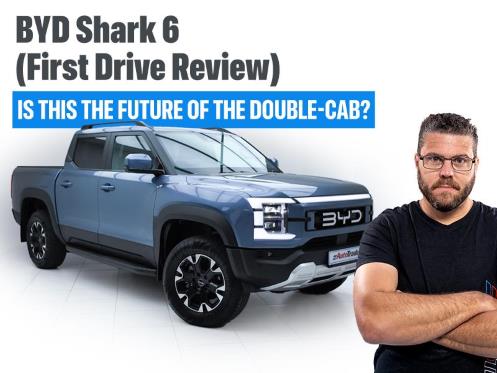
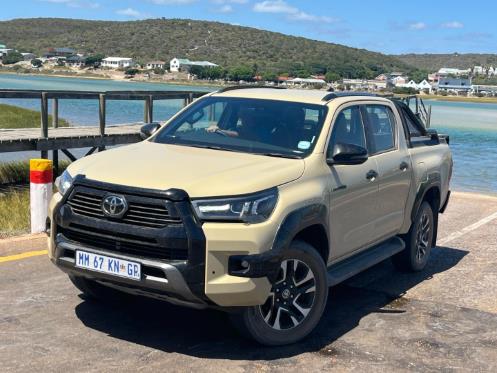
I got the keys to the BYD Shark 6. As the first plug-in hybrid (PHEV) bakkie to hit the South African market last year (2025), it promises to blend the efficiency of an EV with the rugged utility South Africans demand. After putting it through its paces, here are my thoughts.
Fast Facts
Styling
Inspired by its namesake, the front end features a massive "BYD" logo across the grille, flanked by C-shaped LED daytime running lights that create a futuristic light bar effect. The Shark 6 opts for a squared-off, muscular silhouette. Down the sides, you’ll find 18-inch alloy wheels and prominent wheel arch cladding that emphasises its off-road intent. Towards the rear, the LED light bar continues, giving it a high-tech signature at night. It feels more lifestyle than workhorse, competing directly in the premium segment where styling is as important as payload.
I had three people approach me during my week with the car, two while I was topping up the charge at my local DC charger, and another while I was grabbing coffee over the weekend. They all wanted to know about the model, the brand, the price and what it's like to drive a hybrid bakkie. I was more than happy to chat cars with them, particularly when I had about 30 mins to wait for the battery to charge.

Interior
Step inside, and you’ll find a cabin that feels more like a premium SUV than a traditional bakkie. The centrepiece is the 15.6-inch rotating touchscreen—a BYD hallmark—which handles everything from climate control to navigation. The system supports wireless Apple CarPlay and Android Auto and features an "Intelligent Voice Command" system. There is also a digitised instrument cluster and a multi-function steering wheel which allows you to control media, driving and off-road models and toggle through the instrument cluster, among other things.

The quality of the materials inside and the return to physical buttons for key controls are a breath of fresh air. I genuinely looked forward to driving the Shark each day. The dashboard features soft-touch materials with contrasting red stitching, giving it a sporty feel. The centre console houses a wireless charger. The seats are upholstered in artificial leather and offer both heating and ventilation. Rear passengers get respectable legroom thanks to the long wheelbase and a flat floor that makes three-abreast seating much more comfortable than you may imagine.

Performance
The key attraction of the Shark 6 is the DMO (Dual Mode Off-road) platform. The 1.5-litre turbo engine works in tandem with two powerful electric motors. The result is a 321 kW/650Nm, making it one of the most powerful double cabs on the market.
| Vehicle | Power (kW) | Torque (Nm) | Price (R) |
| BYD Shark 6 Premium(plug-in hybrid) | 321 kW | 650 Nm | R 969 900 |
| GWM P500 2.0T HEV(self-charging hybrid) | 255 kW | 648 Nm | R 999 900 |
| Isuzu D-Max 3.0TD (turbodiesel) | 140 kW | 450 Nm | R 934 900 |

Driving Impression
Whether driving on national routes or tackling gravel, the Shark 6 remains impressively quiet. Because it prioritises electric drive, the Noise, Vibration, and Harshness (NVH) levels are significantly lower than in other bakkies. On the daily commute, I found it very easy to live with. There's a button on the centre console that lets you switch from hybrid to all-electric drive, and I used it to maximise my efficiency. During my morning commute, traffic ranges from free-flowing to bumper-to-bumper, so when the road is clear, hybrid mode is most efficient, while electric mode works best during stop/start traffic.
While it makes me very boring at braais, I do enjoy playing with car settings to see how the brands' efforts have paid off. In the case of the Shark, I noted a discernible difference between Eco, Normal, and Sport modes, and while my off-road excursions were limited to gravel roads, I found the configurability impressive. There's also something quite satisfying about driving a bakkie that can hold its own in a drag race with a Golf GTI. We've raced a Shark versus a Ford Ranger Raptor, and let's just say we were impressed. My time with the Shark only cemented my positive impression of its performance, though it slows as the battery runs down.

The suspension is a highlight. Using an independent rear suspension setup rather than the traditional leaf springs found in most bakkies, the primary ride is incredibly smooth over road undulations. However, this setup does impact the heavy-duty towing capacity compared to key rivals. The suspension, focus on performance, road bias tyres and plush interior give one the impression that it is more of a soft-roader
Fuel Consumption
In HEV mode with a charged battery, the Shark 6 can achieve as low as 1.5 L/100 km, according to the brand. From my experience, you can expect real-world consumption to settle between 7.0 and 8.5 L/100 km when using a healthy mix of petrol and electric power. The figure varies significantly depending on the driving style and conditions. The good news is that 700km is quite easily achievable on a single tank (59 litres) and charge (29.6kWh).

Charging
When owning a hybrid, it's important to know the charging performance. Here's what the Shark offers:
- Maximum AC Charge Rate: 7 kW (Single Phase).
- Maximum DC Charge Rate: Up to 50 kW - 55 kW.
- Charging Port: CCS2, located on the rear driver's side.
- Battery Management: The vehicle generally allows usage from 100% down to 25% (or lower) before the engine takes over to charge the battery
Charging Times (0% to 100%)
- DC Fast Charger (50kW+): Roughly 35–40 minutes to charge from 20% to 80%.
- 7 kW Wallbox (AC): ~4.5 hours.
- 16A Charger (Caravan Socket): ~9 hours.
- 10A Plug-in Charger (Standard Socket): 14.5 to 16 hours.
- 8A "Granny" Charger: Up to 18 hours
Safety
The Shark 6 comes standard with a full suite of Advanced Driver Assistance Systems (ADAS), including:
Adaptive Cruise Control (ACC)
Lane Keep Assistance
540-degree Camera (including an "under-car" view for off-roading)
7 Airbags

Verdict
The Shark 6 offers a compelling alternative to the traditional diesel double-cab. For under R1 million, you get performance that eclipses almost everything else in the segment, combined with SUV-like interior comfort and the ability to commute on pure electricity. The BYD is the choice for the tech-forward buyer who wants traffic-light bragging rights. For those looking at something a bit more rough and tumble, there's no shortage of diesel-powered off-road bruisers available. Is this the best plug-in hybrid bakkie for sale in South Africa? In my opinion, at the time of writing, most certainly!