My own booking blunder left us with a Transit Custom Sport instead of a Tourneo Custom passenger vehicle, but it turned out to be a lovely little break from the old routine. Here's how it went down!
Fast facts
| Feature | Specification |
|---|---|
| Vehicle Type | Panel van (SWB Sport) |
| Engine | 2.0-litre Single Turbo EcoBlue diesel (i4) |
| Power | 125 kW @ 3 500 r/min |
| Torque | 390 Nm @ 1 750–2 500 r/min |
| Transmission | 8-speed automatic (column shifter; manual select) |
| Drive | Front-wheel drive |
| 0–100 km/h | Not quoted |
| Top Speed | 180 km/h |
| Fuel Tank Capacity | 55 litres |
| Average Fuel Consumption | 8.0 L/100 km (combined, claimed); 7.2 L/100 km (highway, tested); ~9.0 L/100 km (urban week) |
| Driving Range | Approximately 690–760 km per tank (55 L, usage dependent) |
| Kerb Weight | 1 971 kg |
| Ground Clearance | Not quoted |
| Towing Capacity | 2 500 kg (braked); 750 kg (unbraked) |
| Interior Features | 13-inch SYNC 4 touchscreen; 12-inch digital cluster (8-inch configurable zone); wireless Apple CarPlay/Android Auto; heated front seats with dual armrests; multiple USB-A/USB-C; FordPass Connect |
| Convenience & Comfort | Dual powered soft-close sliding side doors with integrated steps; keyless entry/start; rain-sensing wipers; auto-folding mirrors; optional soft-touch bulkhead with window |
| Safety | 6 airbags (incl. roof-mounted passenger); AEB with Pre-Collision Assist & Collision Mitigation; Reverse Brake Assist; Evasive Steer Assist; Intelligent Adaptive Cruise Control; Lane Keeping Aid; Blind Spot Monitoring & Assist; TPMS; Hill Launch Assist; Roll Over Mitigation; front/rear PDC; 180° split-view reverse camera |
| Pricing | R 938 000 (incl. VAT) |
| Warranty & Service Plan | 4-year/120 000 km warranty; 6-year/90 000 km service plan; 4-year/unlimited roadside assistance; 5-year/unlimited corrosion cover; 15 000 km/12-month intervals |
| Competitors | Mercedes-Benz Vito 114 CDI Panel Van Pro auto; VW Transporter 6.1 2.0 TDI DSG; Hyundai Staria Load 2.2D 8AT; Renault Trafic Panel Van |
Styling
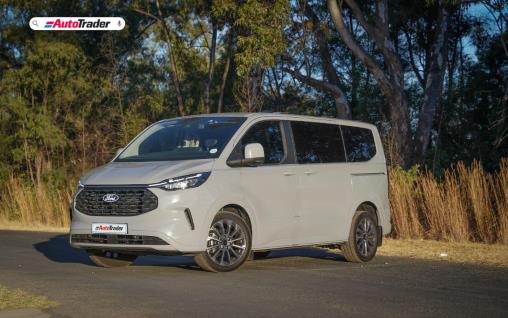
Panel vans usually blend into the background, big on boxiness, light on bravado. The Transit Custom Sport doesn’t blend in, however. Its short‑wheelbase stance looks taut, and Ford’s styling pack gives it proper attitude: a sport body kit with a honeycomb grille up front, a neat rear spoiler, and bold side decals.

Dual racing stripes run from the front bumper over the bonnet and roof to the twin barn doors, so it looks purposeful from every angle. Multi‑spoke 17‑inch matte‑black alloys wrapped in 215/60 R17C tyres add some muscle, while the LED headlights (with signature DRLs and auto high beam) and LED taillights deliver a crisp, premium glow after dark. It’s still a panel van, but it carries itself like it has weekend plans after the deliveries are done.

In our case, there would be no deliveries or an opportunity to play bicycle tour backup. In fact, I didn't have my glasses on when I selected the Ford Transit Custom from a list; I thought I was ordering the Tourneo Custom with actual passenger seats. Only upon collection of the van did I realise my oversight, but when life hands you lemons, you make margaritas.
Interior
With a cabin this plush, you'd think you were in a luxury family bus. The Sport treatment lifts the cabin with cloth seats stitched with blue accents and piano‑black surrounds for the huge SYNC4 infotainment display and driver display. Both front chairs are heated, featuring dual armrests. The driver's seat offers 6-way electric adjustment with lumbar support, while the passenger seat is manually adjustable.

I appreciated the clever cubby hole that looks deceptively shallow, but allows you to store larger items such as laptops without anyone guessing what could be hiding inside, along with a lovely bonus of dual USB-A ports. The central bin also features a deep recess and 1 USB-A and 1 USB-C port, located closer to the driver, allowing for a phone to be stored down below, completely out of sight while driving.

Ford thought of (almost) everything, even the bulkhead is covered with soft-touch material for a quieter cabin (an optional extra), while the triple-tiered doors have even more storage space. Two occupants have a total of six thoughtfully placed cup holders for those Monsters and farm-stall cappuccinos.

Space and Comfort
Since we had a panel van without a plan, I racked my brain trying to think of things to do with it. We're not really into cycling or dirt bikes, and my diving equipment hardly needs a 2602 mm load bay with 1392 mm of width between the arches (that is said to fit three Euro pallets). While the payload of up to 1023 kg would be ideal for business owners, we decided to put some of this vastness to excellent use by going camping instead.

We aren't exactly super-geared campers who can just put everything together on a whim, load up the car, hitch the trailer and drive off, but in this instance, we didn't need to be. We opened the dual, soft-touch sliding doors, loaded a medium-sized mat, one foot stool, a single mattress and its bedding into the van, secured it, threw in two overnight bags and a two-seater couch for good measure, and set off to the pretty town of Greyton (near Caledon) in the Western Cape.
The Drive
On the road, the Transit Custom Sport feels decidedly un-van-like. The engine's 390 Nm of torque is available early (1,750–2,500 r/min), allowing it to pull cleanly and settle into a leisurely cruise, while the 8-speed automatic transmission keeps things smooth.

Steering is light, and the short‑wheelbase/10.9 m turning circle makes tight manoeuvres simpler than you'd imagine in this big slab of a vehicle. Large, dual side mirrors with connected blind-spot mirrors below, front and rear PDC and the 180° split‑view camera will reduce stress in alleys and loading bays, and the available driver aids (blind‑spot assist, lane keeping, adaptive cruise) ease the long stints. It is a surprisingly enjoyable van to drive, and you have a selection of modes to choose from:
- Normal: For everyday balance
- Eco: Softer responses to save fuel
- Slippery: Gentler throttle/traction for wet or loose surfaces
- Tow/Haul: Recalibrated shifts for heavy loads or trailers
- Sport: Snappier throttle and quicker shifts for brisker progress
Performance
Quick overtakes don't require much planning; flicking to Sport mode sharpens throttle and shift timing, and you can tap manual selection on the column shifter when you want to hold a gear, although we didn't have nearly enough cargo in the load bay to affect pulling power significantly. The 2.0-litre Single-Turbo EcoBlue diesel engine delivers 125 kW at 3,500 r/min and 390 Nm from 1,750–2,500 r/min. Top speed is quoted at 180 km/h.

Arriving in Greyton
Lunch followed shortly at the pretty-as-a-picture Abbey Rose on the main road (owned by a Spanish madre who cooks unbelievable seafood). After visiting my new favourite all-natural perfumery (Yves Authentics), two charity shops, and an antique store, we decided to find a place to park our van for the night. Out of all the campsites, we opted for the most affordable, so we would have a bigger budget for food: Twin Rivers Campsite in Krige Road.

"Camping" at Twin Rivers
Wendy, the friendly owner, said there were plenty of shady sites left to set up camp, and we settled on a lovely spot overlooking the river for only R320 (two adults, one night). To stake our claim (since we had no tent), we unloaded our cat-ravaged floral couch and drove back into town for supplies, much to the amusement of the more serious campers hammering tent pegs into the ground.

We returned with only wine, snacks, and wood for atmosphere, because we didn't plan on cooking. At sunset, we hopped into the van again and drove down the dirt road back to the village to our favourite restaurant, Oak & Vigne Café, where all the Greyton locals hang out.

Carleen and Diego were on duty, mixing the meanest cocktails and treating customers like family. (A five-star review followed on Google; their pizzas are delicious.) With full bellies, we returned to the campsite in excellent spirits.

From panel van to caravan
After enjoying the campfire ambience from our couch for an hour or so, we decided it was time for bed. It was then that I regretted my decision to insist that the single mattress would be big enough for both of us; as we had both become a little wider since we first met in 2015!

The other issue is that there is no ventilation in the load bay when the van's doors are closed. When you open any of the doors, the bright overhead lights come on, burning all the sleep-inducing melatonin through your retinas. If only the window in the bulkhead could open, one would at least be able to let in some fresh air via the large windows up front, but this was not possible.

Fortunately, it was a chilly night, and with the doors and windows closed, the temperature was just right. (I would have frozen in a tent.) Once inside, you had better have a light source nearby to locate the door handles for the exits. The car keys, phones, a torch, etc, would have to be within arm's reach of your 'bed'. The upside is that it's quiet, wind-proof, and no mozzie or bug will find its way inside while you sleep. Earlier on, the avid campers came to inspect our stylish abode and admitted they were very jealous. (They had even tried out our abandoned couch while we were in town!)
By 3 am, my joints were aching, so we changed our sleeping position to resemble a pair of heels in a shoebox, with the heels to the toes (or feet to face). I drifted off and caught an hour or two of semi-comfortable sleep, even though my dreams entailed trying not to fall off the edge of a cliff.
Fuel Consumption
At 6 am, bleary-eyed, we "packed up camp" in about seven minutes flat and high-tailed out of there, feeling sorry for our neighbours who would take hours to vacate the premises later. Next stop: Caledon Fresh Stop for coffee!
During the week, when we travelled the highway from Cape Town with town driving in between, our average diesel consumption was 8.3 litres per 100 km, but I wanted a better idea of the van's long-haul consumption. Soon enough, the trip computer showed 7.2 litres per 100 km. For the rest of the week's commutes in traffic, 9 l / 100 km was the average. Remember, the load bay was relatively empty, so when you have pallets full of stuff, things may look a little different. Based on this, we would have gotten around 650 to 760 from one 55-litre tank.
Related: Ford Tourneo Custom Review (2025)

As for AdBlue, the clear urea‑and‑water fluid that helps the Transit clean up its exhaust; it lives in its own 20‑litre tank with a blue cap (separate from diesel) and the van doses it automatically, so you don’t have to think about it. A single top-up usually lasts for thousands of kilometres. The dash warns you well in advance when it’s getting low, and you can refill it at most service stations or parts stores. In short, it is affordable, easy, and one of the reasons this diesel runs cleaner. A 10-litre can will cost you from R225.
Safety
For a panel van, the Transit Sport is overqualified. Six airbags (including the clever roof-mounted passenger airbag) and a comprehensive set of driver aids, as previously mentioned, work in the background. With collision mitigation, Reverse Brake Assist, and Evasive Steer Assist, there is protection for the unexpected. Back at camp, shielded power deadlocks, two-step unlocking, and a Thatcham Cat 1 alarm kept our property safe, and FordPass allowed us to double-check the locks via the app on my phone.

Price
If you’re wondering what our stylish utility “camper” costs, the Transit Custom 2.0SiT SWB Sport comes in at R938 000 (incl. VAT). That price includes a 6‑year/90 000 km service plan, a 4‑year/120 000 km warranty, 4‑year/unlimited roadside assistance and 5‑year/unlimited corrosion cover, with 15 000 km/12‑month service intervals and an optional maintenance plan up to 165 000 km.

The closest on paper is the Mercedes-Benz Vito 114 CDI Panel Van Pro (auto), which sits a touch higher at R969,311. You could also consider the VW Transporter 6.1 Panel Van (2.0 TDI DSG) at R854 604, while the Hyundai Staria 2.2D panel van is priced considerably lower at R679 500. Each offers its own unique blend of space, value, and brand appeal.
Ford Tourneo vs. Hyundai Staria vs Kia Carnival
The Verdict
Driving a panel van doesn't sound like a whole lot of fun, until you make the Ford van your recreational vehicle for the weekend.
The Ford’s trump card is its Sport treatment and tech-rich cabin: it feels less “fleet special” and more like something you’ll happily drive all week, and potentially sleep in on the weekend, if the temperature allows. It's one of those cars where you feel that you need at least another few weeks with it!